
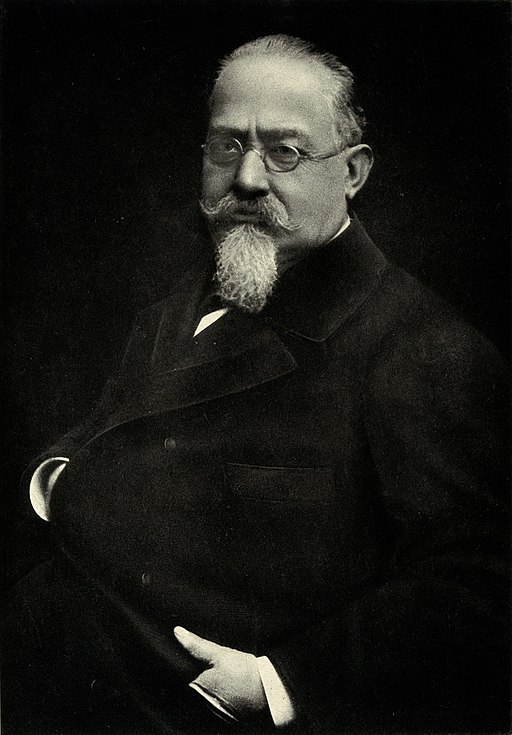
Cesare Lombroso (1835 – 1909) was an Italian physician, psychiatrist and anthropologist, best known for his theory of the born criminal. He is regarded as the founder of the positivist, or biological, school in criminology: he was the first to try to explain crime through biological and anthropological factors, using methods borrowed from the natural sciences, namely careful observation, measurement and weighing. [1]
Although many of his conclusions were later refuted empirically, his work shaped the development of criminology, forensic science and criminal policy. D. Garland goes so far as to call the whole positivist strand of criminological enquiry, the search for the causes of crime in the traits that set the criminal population apart from the non criminal one, the „Lombrosian project“. [2]
Life and academic career
Cesare Lombroso was born on 6 November 1835 in Verona, Italy, into a Jewish family. He studied medicine in Pavia and continued his studies in Padua, Vienna and Paris. [3] He began his professional career as an army physician, where he was able to observe mental illness and physical abnormality at close range and over long periods.
From 1862 to 1876 he was professor of psychiatry at the University of Pavia, and from 1871 he ran the asylum in Pesaro. In 1876 he moved to the University of Turin as professor of forensic medicine and hygiene; in 1896 he took the chair of psychiatry there and in 1906 the chair of criminal anthropology. [4]
The combination of academic and prison practice was decisive for him: he also served as prison doctor at the Turin penitentiary, which brought dozens of convicts through his surgery every day. [5] By his own account, the idea of atavism first occurred to him during the autopsy of the well known brigand Villella, whose physiognomy and skull showed numerous anomalies. [6]
Lombroso was a pioneer in applying scientific methods to the study of crime, and in doing so laid the foundations of modern criminology. He continued his scholarly work until his death on 19 October 1909 in Turin.
The period: from the classical to the positivist school
Lombroso’s contribution only makes sense against the background of a dispute between two approaches. The classical period of criminology, represented by C. Beccaria and J. Bentham, concentrated on the act, on the proportionality and certainty of punishment and on the legality of criminal proceedings; the person of the offender was of almost no interest. [7] In the second half of the nineteenth century, however, positivism came to the fore. Its premise was that criminal behaviour can be studied objectively, and that understanding biological, psychological and social factors reveals the causal relationships that matter. [8]
Lombroso drew on the work of F. J. Gall, the founder of phrenology, who assumed a correlation between peculiarities in the structure of the skull and mental characteristics; his second source was Darwin’s theory of evolution. [9] It was this combination, measuring the body and explaining it in evolutionary terms, that produced his central idea.
The theory of the born criminal
Lombroso believed that criminals are not born like other people but are different from birth, not only psychologically but physiologically. Working from anthropological research, he recorded physical peculiarities in some 25,000 convicts in Italian prisons [10] and concluded that the criminal is an atavistic being in whose personality the wild instincts of primitive humans and of the phylogenetic ancestors of man reappear. [11] This amounts to a degenerative return to a more primitive, subhuman stage of development. [12]
In his foundational work L’uomo delinquente (Criminal Man) of 1876 he argues that the criminal is born with biological dispositions that determine him towards delinquency. [13] Among the traits by which a born criminal could be recognised he listed above all:
- Facial asymmetry – in his view the skull of criminals is uneven or deformed.
- Pronounced frontal bones – heavy brow ridges and a low, receding forehead.
- Large jaws and a protruding chin – features he considered atavistic and ape like.
- Long arms and short legs – an anatomical disproportion of the body.
- Unusually large or small ears – often protruding, with attached lobes.
- Further „stigmata of degeneration“ – deformed fingers, squinting, an atypical size and shape of the skull, anomalies of the teeth and the palate. [14]
The summary description of these traits, still quoted in textbooks today, runs: „A markedly asymmetrical face; excessively large gums and cheekbones; unusually large or, conversely, small ears, often protruding like a chimpanzee’s; a hooked, upturned or otherwise deformed nose; fleshy, swollen lips; unusually long arms; unusual shapes of the palate or a cleft in it; abnormal teeth; a receding chin, or one unusually long or short and flat, as an ape has.“ [15]
Lombroso took the argument further still, tying outward physical traits to particular kinds of offence: he attributed a disposition to forgery and arson to hunchbacks, held that a robber could be recognised by dark eyes and thick dark hair, and ascribed to murderers glassy, glittering eyes, thin lips, a large nose and wavy hair. [16] It is precisely these constructions that later became the most vulnerable part of his teaching.
A typology of criminals
Lombroso’s typology changed over his lifetime. In its mature form, alongside the born criminal, who in his estimate committed about 40 % of all crime, he distinguished the mentally ill criminal (the intellectually disabled, epileptics, the paralytic) and the so called criminaloid, the occasional offender. [17] Later works added criminals of passion, who offend under the force of strong emotion, and individuals capable of reform. [18]
He gave separate attention to female crime. In La donna delinquente, la prostituta e la donna normale (1893), written with G. Ferrero, he argued that women commit fewer offences than men and that criminal women display „masculine“ physical and temperamental traits. This conclusion too is now among the most sharply criticised parts of his work.
Lombroso’s typology was developed further by his pupil Enrico Ferri (1856 – 1928), who extended it to five categories:
- born criminals,
- mentally ill criminals,
- habitual criminals,
- criminals of passion and
- occasional criminals
Alongside anthropological causes he explicitly admitted psychological, geographical and socio economic factors as well. [19]
The effect on criminal law and forensic science
Lombroso’s theories had a substantial effect on criminology and forensic psychology. It is thanks to him that the personality characteristics of offenders began to be studied scientifically, which in turn led to the development of offender profiling.
His work also had practical consequences:
- It helped lay the foundations of modern forensic anthropology.
- It shaped the development of biological theories of crime, the constitutional typologies of E. Kretschmer and W. H. Sheldon as well as later genetic research. [20]
- It prompted debate about the causes of crime, whether crime is inherited or the product of the environment.
- It opened the ground for later victimology: victims are mentioned in the work of the first criminologists, Lombroso, Garofalo and Ferri, although fuller research centred on the victim only began around 1950. [21]
The appeal the theory held at the time is borne out by police practice. In the 1880s the main police department of the City of New York was inspired by it far enough to start collecting photographs of arrested offenders and sorting them systematically by type of offence. The hope that murderers, thieves and fraudsters share identifying traits was not borne out, and the department soon abandoned the effort. [22]
Criticism and the rejection of his theories
Although Lombroso brought a scientific approach into criminology, his theories were later refuted. The main objections to his work can be summarised as follows:
- Methodological shortcomings – Lombroso worked with an unrepresentative sample of prisoners, as a rule without a control group drawn from the non criminal population. [23]
- Empirical refutation – the most thorough control study was carried out by the English prison doctor Charles Goring, who, on a sample of more than 3,000 convicts and with control groups of soldiers and students, concluded that no „somatic criminal type“ exists. [24]
- Prejudice and misuse – his conclusions became a prop for racist and eugenic ideologies; S. J. Gould gave a critical analysis of the whole tradition of „measuring man“. [25]
- Neglect of social factors – G. Tarde had already rejected the biological determinism of Lombroso and his followers, arguing that social progress weakens the influence of physical factors. [26] Contemporary criminology treats social and economic conditions as one of the principal determinants of crime.
- No confirmation by modern research – genetic and psychological studies have not confirmed that crime is conditioned by inborn physical traits.
The verdict on Lombroso’s work is not uniformly dismissive, however. As Heretik points out, „Lombroso’s work is judged, rather unfairly in historical terms, as pseudo science, although it rested on extensive empirical material“; it is a clear case of overrating one determinant of crime rather than an absence of scientific method. [27] For all the objections, his work inspired later generations of criminologists in their search for objective causes of crime.
Later life and legacy
Lombroso modified his theory repeatedly during his lifetime. Alongside inborn dispositions he paid growing attention in his later years to social, cultural and economic influences, poverty, alcoholism, emigration and migration, and conceded that the born criminal is not the only type of offender. [28] It was this emphasis on the multifactorial conditioning of criminal behaviour that shaped the further development of the discipline, as the work of his successors E. Ferri and R. Garofalo confirms. [29]
His most important works include:
- L’uomo delinquente (Criminal Man), 1876 – the principal work, in which he set out the theory of the born criminal. Over successive editions (1878, 1884, 1889 and the fifth of 1896 – 1897) the text grew from a single volume into an extensive multi volume work; an English selection from the various editions appeared under the title Criminal Man only in 2006. [30]
- La donna delinquente, la prostituta e la donna normale (The Criminal Woman, the Prostitute and the Normal Woman), 1893 – co authored with G. Ferrero.
- Le crime, causes et remèdes (Crime, Its Causes and Remedies), 1899 – an attempt to join biology and sociology in criminology; it appeared in English in 1911 as Crime: Its Causes and Remedies.
Even though his theories were wrong in many respects, his influence on forensic science, psychology and criminology is undeniable. Y. Jewkes goes as far as to argue that the concept of the born criminal survives today in the media: in particularly brutal cases the offender is portrayed exactly in the spirit of the theory, as a monster that has nothing, and can have nothing, in common with any of us. [31]
Summary and significance
Cesare Lombroso was a controversial but important criminologist who tried to understand crime scientifically. Although his theory of the born criminal was later refuted, his work contributed to:
- the development of forensic anthropology and psychology,
- laying the foundations of modern criminology as an empirical science,
- the debate about the biological and social causes of crime.
We now know that crime is not inborn but the product of a great many biological, psychological and, above all, social factors. Lombroso nevertheless remains a historically significant figure, one who helped turn criminology into a scientific discipline [32] and whose fate serves as a standing warning against carrying unverified biological constructions into criminal policy.